Understanding AI Types: Narrow, General, Super
As we navigate an era increasingly defined by artificial intelligence, it's essential to grasp the distinct types of AI that shape our technology landscape. With insights from experts, this exploration will enhance your understanding and spark curiosity about the future possibilities of AI.
What You Will Learn
- Narrow AI is the most prevalent form of AI today, specializing in specific tasks without broader comprehension.
- General AI, still theoretical, aims for human-like adaptability and cognitive abilities across various tasks.
- Super AI, a concept that exceeds human intelligence, raises significant ethical concerns regarding its development and control.
- Understanding the characteristics of each AI type is crucial for navigating the future landscape of technology and ethics.
Understanding AI Types: Narrow, General, and Super AI
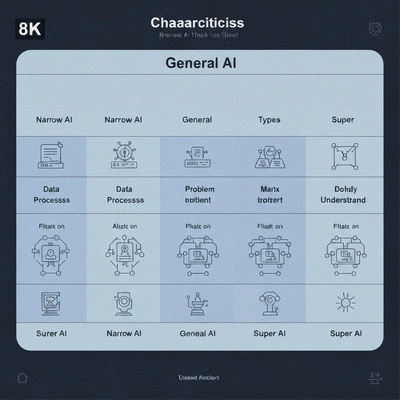
This visual outlines the distinctions and characteristics of Narrow AI, General AI, and Super AI, highlighting their current prevalence, future potential, and ethical considerations.
Narrow AI (Weak AI)
Current Standard: Task-specific intelligence.
- Designed for specific tasks (e.g., voice assistants, recommendations).
- Operates within limited context.
- Requires extensive data within its niche.
Prevalence: High
General AI (AGI)
Future Goal: Human-like adaptability across tasks.
- Learns from experience, reasons in various contexts.
- Possesses cognitive functions similar to humans.
- Theoretical, but revolutionizes industries.
Prevalence: Theoretical
Super AI
Boundary Pushing: Surpasses human intelligence.
- Unmatched problem-solving, self-improvement.
- Potential to outperform humans in every field.
- Raises significant ethical and control concerns.
Prevalence: Hypothetical
Ethical & Future Focus
Key Questions: Responsible development and impact.
- User privacy, bias prevention in algorithms.
- Governance in sensitive areas (healthcare, justice).
- Fostering trust and transparency.
Future Outlook: Critical
Clarifying AI Types: An Overview of Narrow AI, General AI, and Super AI
When we think about artificial intelligence, it’s crucial to understand its various forms. At Positive About AI, we strive to clarify these concepts for our readers, ensuring that everyone can grasp how AI functions and the potential it holds. In this section, we'll explore three main types of AI: Narrow AI, General AI, and Super AI.
Understanding these distinctions not only helps in appreciating the current capabilities of AI but also sheds light on what the future might hold. Let’s dive in!
Defining Narrow AI: The Current Standard in Artificial Intelligence
Narrow AI refers to AI systems that are designed to perform specific tasks. Unlike humans, these systems cannot think or reason beyond their predefined functions. They excel in their niche but lack the flexibility and comprehension that comes with broader intelligence.
This specialization is what makes Narrow AI the most prevalent form of AI today. From chatbots to recommendation engines, Narrow AI is already integrated into many aspects of our daily lives. The AI Index Report offers comprehensive insights into the current state and trends of AI, highlighting the dominance of Narrow AI applications.
Characteristics of Narrow AI: Task-Specific Intelligence
- Designed for specific tasks or problems
- Operates within a limited context
- Requires extensive data to function effectively
These characteristics highlight how Narrow AI systems rely heavily on narrow datasets, which limits their ability to adapt to new situations or contexts. For example, an AI that can play chess cannot apply its intelligence to driving a car!
Everyday Applications: Real-World Examples of Narrow AI
- Voice assistants like Siri and Alexa
- Recommendation systems on Netflix and Spotify
- Fraud detection systems used by banks
These examples illustrate how Narrow AI enhances our lives, often in ways we might not even notice. For instance, the next time you binge-watch a show on Netflix, remember that Narrow AI played a role in suggesting your next favorite series!
Exploring Weak AI: The Limits of Narrow AI
While Narrow AI is impactful, it is often referred to as Weak AI due to its limitations. These systems don’t possess understanding or consciousness; they simply follow algorithms. It’s an important distinction to note, as this emphasizes the necessity for responsible development and application.
As we continue to develop AI technologies, understanding these limitations can help guide ethical discussions about AI's role in our future. Remember, at Positive About AI, we’re committed to fostering optimism while respecting the boundaries of technology!
Understanding General AI: Theoretical Advancements and Future Goals
General AI represents a form of intelligence that can understand, learn, and apply knowledge across a wide range of tasks, similar to human abilities. This type of AI is still theoretical, but it sparks incredible interest and debate in the tech community. Initiatives like AI in Action showcase efforts and discussions around advancing AI capabilities towards more general intelligence.
The journey toward achieving General AI is fascinating, and at Positive About AI, we believe that exploring these possibilities is essential for understanding AI’s potential impact on society.
Characteristics of General AI: Human-like Adaptability
- Ability to learn from experience
- Can reason and solve problems in various contexts
- Possesses cognitive functions similar to humans
With these traits, General AI could revolutionize industries by performing tasks that require human-like cognitive skills. However, the road toward this goal is filled with challenges and ethical dilemmas.
Potential Applications: How General AI Could Transform Industries
- Healthcare: Personalized patient care and treatment plans
- Education: Tailored learning experiences for students
- Transportation: Fully autonomous vehicles
These applications highlight how General AI could fundamentally change our approaches to various fields, making them more efficient and effective. Imagine a future where your doctor’s assistant is an AI that understands your health history and provides customized advice!
AGI vs. Human-Level AI: Understanding the Differences
It’s important to differentiate between AGI (Artificial General Intelligence) and human-level AI. While both aim for broad cognitive capabilities, AGI focuses on replicating human intelligence in machines. This distinction is vital for discussions about ethics and safety in AI development.
As we explore these exciting frontiers, remember that discussions about AI should always prioritize ethical considerations and human values.
Exploring Super AI: Theoretical Concepts and Ethical Implications
Super AI is a concept that pushes the boundaries of what we think is possible. This type of AI would surpass human intelligence, enabling it to solve complex problems beyond human comprehension. The Stanford AI Index Report frequently discusses theoretical advancements and future outlooks for AI, including the hypothetical development of Super AI.

As thrilling as the idea of Super AI might be, it also raises significant ethical questions. At Positive About AI, we emphasize the need for careful consideration of these implications as we advance toward such technologies.
Characteristics of Super AI: Beyond Human Intelligence
- Unmatched problem-solving abilities
- Self-improvement and evolution
- Potential to outperform humans in every field
If realized, Super AI could deliver unprecedented advancements. However, it’s essential to approach this possibility with caution, ensuring that our technological advancements align with ethical standards.
Ethics and Risks: Concerns Surrounding Super AI Development
With great power comes great responsibility! The development of Super AI brings forth concerns about control, decision-making, and the potential risks involved. Discussions on governance and ethical frameworks are essential to navigate this uncharted territory.
As we strive for innovation, the mission at Positive About AI is to ensure that these discussions are inclusive, transparent, and focused on benefiting humanity.
The Turing Test: Measuring Super AI's Capabilities
The Turing Test is a key benchmark for assessing whether an AI can exhibit intelligent behavior indistinguishable from that of a human. While passing this test is a significant milestone, it’s crucial to remember that intelligence encompasses more than just mimicking human responses.
As we consider the implications of AI development, let’s keep an open dialogue around its potential and the impacts it can have on our society, ensuring that we always place humanity at the forefront of innovation.
Frequently Asked Questions About AI Types
- What are the three main types of AI discussed in the article?
- The article discusses three main types of AI: Narrow AI (or Weak AI), General AI (or Artificial General Intelligence - AGI), and Super AI.
- What is Narrow AI?
- Narrow AI is AI designed to perform specific tasks only. It excels in its niche, such as voice assistants or recommendation systems, but lacks broader intelligence or comprehension.
- Is General AI currently available?
- No, General AI is currently theoretical. It aims for human-like adaptability and cognitive abilities across various tasks but has not yet been achieved.
- What characteristics define Super AI?
- Super AI is characterized by unmatched problem-solving abilities, self-improvement, and the potential to outperform humans in every field. It is a hypothetical concept that exceeds human intelligence.
- Why are ethical considerations important in AI development?
- Ethical considerations are crucial to ensure responsible development, address concerns about user privacy and bias in algorithms, establish governance in sensitive areas like healthcare, and foster trust and transparency in AI's impact on society.
We Want to Hear From You!
As we explore the various forms of AI, we invite you to share your perspective: Which type of AI do you believe will have the most significant impact on our future? Let us know your thoughts below:
Summarizing the Journey Through AI Types
As we reflect on our journey through the fascinating landscape of artificial intelligence, it's clear that Narrow AI is the current standard, holding a dominant position in various industries. This task-specific intelligence has woven itself into our daily lives, impacting everything from customer service to healthcare. However, as we look toward the future, the potential of General AI and Super AI is capturing the imagination of innovators and thought leaders alike, including us at Positive About AI.
The path forward will not only involve technological advancements but will also require us to address the ethical implications of these innovations. We stand at a pivotal moment where the decisions we make today could shape the AI landscape for generations to come!
The Current Landscape: Dominance of Narrow AI and Emerging Trends
Currently, Narrow AI is prevalent in numerous applications, providing efficient solutions to specific problems. As its use continues to grow, we see emerging trends that indicate an ongoing evolution of AI capabilities. Here are some key trends to consider:
- AI-driven customer support tools enhancing user experience
- Machine learning algorithms optimizing logistics and supply chains
- Smart home devices offering convenience and efficiency
- Healthcare AI analyzing patient data for better outcomes
These advancements showcase how Narrow AI is not just a buzzword but a vital component of modern technology, providing valuable insights and improving efficiencies across various sectors. At Positive About AI, we share stories of how these technologies are making a real difference!
Looking Ahead: The Future of General and Super AI
The future of AI is undeniably exciting, with General and Super AI on the horizon. These advancements promise to push the boundaries of what artificial intelligence can achieve. Let's explore some key components of this anticipated future:
Real-World Benchmarks and Development Timelines
As we anticipate the arrival of General and Super AI, it’s essential to establish benchmarks that guide our progress. These include:
- Increased adaptability of AI systems to learn and evolve
- Successful prototypes demonstrating human-like problem-solving skills
- Collaborative efforts between developers and ethicists to ensure responsible innovation
These benchmarks will help us understand when we might see tangible progress toward these advanced forms of AI.
Ethical Considerations for Future AI Innovations
With great power comes great responsibility! As we move toward more advanced AI, we must consider the ethical implications of our innovations. Critical questions include:
- How will we ensure that AI systems respect user privacy?
- What guidelines will govern the use of AI in sensitive areas like healthcare and justice?
- How can we prevent bias in AI algorithms?
At Positive About AI, we believe these discussions are crucial to fostering trust and transparency in how AI is developed and utilized.
Autonomous Systems and Robotics: The Next Frontier in AI
Looking further ahead, the development of autonomous systems and robotics represents a significant frontier in AI. These systems will not only change how we interact with technology but also how we navigate our environments. Here are some exciting possibilities:
- Robots performing complex tasks in manufacturing and logistics
- Autonomous vehicles reshaping transportation
- AI-powered drones enhancing delivery systems and emergency response
These innovations promise to bring about transformative changes in both industry and daily life. It's an exhilarating time to be engaged in the AI conversation!
Recap of Key Points
Here is a quick recap of the important points discussed in the article:
- Narrow AI is the most prevalent form of AI today, designed for specific tasks and integrated into many aspects of daily life.
- General AI represents a theoretical form of AI that could learn and apply knowledge across various tasks, similar to human intelligence.
- Super AI would surpass human intelligence, raising significant ethical questions that must be addressed as technology advances.
- Understanding the distinctions between these types of AI is crucial for appreciating their current capabilities and potential future impact.
- Ethical considerations are essential in AI development, ensuring that innovations align with human values and societal benefits.

Elena R. Caldwell
Elena R. Caldwell is a passionate advocate for the ethical advancement of artificial intelligence. With a background in technology journalism and an extensive understanding of emerging AI trends, she is dedicated to showcasing the positive impact of AI across industries. Through her work at Positive About AI, Elena aims to foster a deeper understanding of intelligent technologies, ensuring they are perceived as transparent and empowering tools for the future.
Popular Posts
AI Governance for Business Growth
![How AI Governance Can Drive Competitive Advantage and Innovation]() In an era where technology evolves at breakneck speed, the role of AI governance is more critical th
In an era where technology evolves at breakneck speed, the role of AI governance is more critical th
 In an era where technology evolves at breakneck speed, the role of AI governance is more critical th
AI Technology: Trends and Innovations
![The future of AI technology: Emerging trends and innovations]() As we venture into a future increasingly shaped by artificial intelligence, it’s vital to understa
As we venture into a future increasingly shaped by artificial intelligence, it’s vital to understa
 As we venture into a future increasingly shaped by artificial intelligence, it’s vital to understa
AI in Marketing: Real Success Stories
![The Future of AI in Marketing: Success Stories of AI-Driven Campaigns]() In an age where technology evolves at an unprecedented pace, the integration of artificial intellige
In an age where technology evolves at an unprecedented pace, the integration of artificial intellige
 In an age where technology evolves at an unprecedented pace, the integration of artificial intellige
Implementing AI Responsibly in Business
![Practical Guide to Implementing AI Innovations Responsibly in Your Organization]() In a world where technology is rapidly evolving, the importance of ethical considerations in artific
In a world where technology is rapidly evolving, the importance of ethical considerations in artific
 In a world where technology is rapidly evolving, the importance of ethical considerations in artific
